

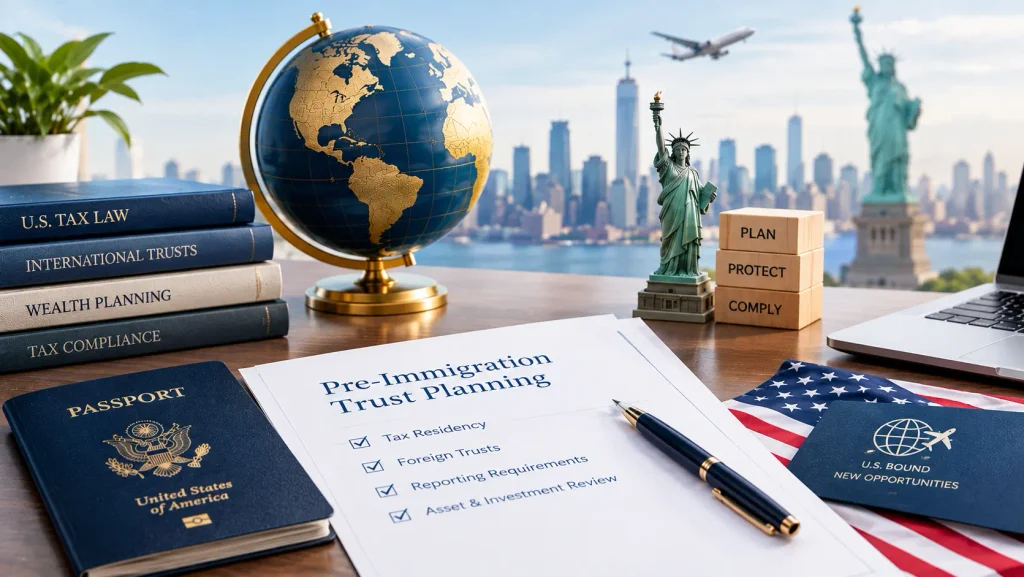
Moving to the United States for business, investment, education or family reasons can create new opportunities. However, if you own international investments, have an offshore company or are a beneficiary of a foreign family trust, your move may also bring important U.S. tax and reporting obligations.
The United States generally taxes its citizens and tax residents on their worldwide income, subject to applicable exceptions and treaty rules. The timing of your move can therefore affect how your foreign trust, investments and other assets are treated.
Reviewing your arrangements before becoming a U.S. tax resident can help you identify potential risks, understand your reporting obligations and evaluate appropriate planning options.
International Tax Consultants (ITC) helps individuals and international families navigate U.S. cross-border tax matters. If you have a foreign trust or expect to receive distributions from one, consider reviewing your position before your U.S. tax residency begins.
1. Understand When U.S. Tax Residency Begins
One of the first steps in pre-immigration tax planning is determining when you become a U.S. tax resident.
Two important tests are:
- Green card test: You generally become a U.S. tax resident when you meet the lawful permanent resident test, subject to special rules affecting the residency starting date.
- Substantial presence test: This generally considers your days physically present in the United States during the current year and the two preceding years. You must generally be present for at least 31 days in the current year and meet a weighted total of 183 days over the three-year period.
Exceptions, treaty provisions and special rules may affect the result. Immigration status and U.S. tax residency are related but are not identical. Obtaining a visa or entering the country does not, by itself, determine every tax-residency question.
Why does the residency date matter?
Before becoming a U.S. tax resident, you are generally subject to different U.S. tax rules from those that apply afterward. Nonresidents may still owe U.S. tax on certain U.S.-source income or income effectively connected with a U.S. trade or business.
Once you become a U.S. tax resident, your worldwide income generally becomes relevant to your U.S. income tax return. Establishing the correct residency date is therefore an important starting point for reviewing foreign trusts and investments.
2. Foreign Trusts: Who Is Taxed on the Income?
A foreign trust can create different U.S. tax consequences depending on whether it is classified as a grantor trust or a nongrantor trust.
Under the grantor-trust rules, another person may be treated as the owner of some or all of the trust’s assets. The income attributable to that portion is generally reported by the person treated as the owner.
The U.S. owner rules
If a U.S. person transfers assets to a foreign trust, certain rules under Internal Revenue Code Section 679 may treat that person as the owner of the trust’s assets when the trust has, or is treated as having, a U.S. beneficiary, subject to applicable exceptions.
If you become a U.S. tax resident and are treated as the owner of a foreign trust, you may have to report the relevant trust income on your U.S. tax return even if the trustee does not distribute the money to you.
The outcome depends on the trust deed, its beneficiaries, who contributed the assets and the applicable tax rules. A trust is not automatically a grantor trust simply because its creator is still alive.
What should you review before moving?
Review the trust deed and amendments, who contributed the assets, who may receive distributions, the powers retained by the grantor, and the trust’s income and distribution history. These details can help determine whether any portion of the trust may be treated as owned by a U.S. person after your residency begins.
3. Accumulated Income and the Foreign Trust Throwback Tax
A foreign trust may accumulate income for years before distributing it to a beneficiary. If that beneficiary becomes a U.S. tax resident, the tax treatment of a later distribution may require careful analysis.
Certain distributions of accumulated income from a foreign nongrantor trust can trigger the foreign trust throwback tax, which involves a special tax calculation and an interest charge.
The throwback tax does not automatically apply to every foreign trust distribution. The result depends on the trust’s classification, the composition of the payment, the trust’s income and distribution history, and the applicable tax rules.
Can distributing income before moving help?
The timing of a trust distribution may affect its U.S. tax treatment. A distribution received before someone becomes a U.S. tax resident may be treated differently from one received afterward.
However, distributing accumulated income before moving does not guarantee that the payment will be tax-free. The outcome may depend on the beneficiary’s tax status at the time, the type and source of the income, the trust’s classification and the tax laws of the relevant countries.
A distribution may also affect other beneficiaries or have consequences under the trust deed. Before requesting a large payment, obtain professional advice on its potential tax and legal consequences and how it should be documented.
4. Review Your Investment Assets and Tax Basis
Another important pre-immigration planning issue is the tax basis of assets you own before becoming a U.S. tax resident.
Tax basis is generally used to calculate a taxable gain or loss when an asset is sold. It often begins with the purchase cost and may be adjusted by certain later events.
For example, suppose you bought shares for $100,000 and they are worth $300,000 when you move to the United States. The increase in market value does not, by itself, mean your U.S. tax basis automatically becomes $300,000.
If you later sell the shares, the tax consequences depend on your basis, the type of asset, the timing of the sale and any applicable exceptions.
Does selling assets before moving create a step-up in basis?
Selling an asset before moving is not the same as receiving an automatic step-up in basis. If you sell an asset and use the proceeds to buy another, the new asset generally has a cost basis based on its purchase price, subject to applicable rules.
The original sale may itself create tax consequences in the country where you live or under other relevant tax rules. Selling or reorganising investments is therefore not a universal tax-saving strategy.
For assets held through a foreign trust, the analysis may be more complicated because the trust’s classification and the identity of the tax owner can affect the outcome.
5. Should You Move a Foreign Trust to the United States?
Some families consider changing a foreign trust’s administration or establishing a domestic trust arrangement when a beneficiary moves to the United States.
However, changing a trust’s location does not automatically resolve existing tax issues or eliminate all reporting obligations.
For U.S. federal tax purposes, a trust generally must satisfy both of the following tests to qualify as domestic:
- Court test: A U.S. court can exercise primary supervision over the trust’s administration.
- Control test: One or more U.S. persons have the authority to control all substantial decisions of the trust.
Simply appointing a U.S. trustee, moving assets to a U.S. bank account or changing the trust’s name does not necessarily satisfy both tests.
Before changing a trust’s jurisdiction or administration, review whether the proposed arrangement will qualify as domestic, whether restructuring could trigger tax or reporting consequences, how accumulated income will be treated, and what legal requirements apply in the country where the trust was established.
Changes to the trust may also affect the rights and interests of other beneficiaries. Obtain professional advice before amending the trust deed or moving assets.
6. What If Only One Family Member Is Moving to the U.S.?
In international families, one beneficiary may move to the United States while other family members remain overseas. This can raise questions about the existing trust’s suitability and whether the family should consider a different arrangement.
Removing a person as a beneficiary or splitting a trust is not a simple way to eliminate U.S. tax exposure. The outcome depends on the trust’s terms, the person’s existing rights, the trustee’s powers and the applicable tax rules.
Restructuring can also affect relatives who remain abroad. Before making changes, obtain advice on the legal and tax consequences for everyone involved. The goal should be a lawful, workable arrangement that reflects the family’s circumstances rather than relying on changes in wording to achieve a particular tax result.
7. Understand the Reporting Requirements
After becoming a U.S. tax resident, you may have additional information-reporting obligations involving a foreign trust. The required forms depend on your role and the transactions involved.
Form 3520
Form 3520 reports certain transactions involving foreign trusts, including reportable transfers, distributions and situations involving a U.S. person treated as the owner of a foreign trust. It is also used to report certain large gifts or bequests from foreign persons.
A filing requirement may apply even when a distribution is not taxable income.
Form 3520-A
Form 3520-A is the annual information return for a foreign trust with a U.S. owner under the grantor-trust rules.
The U.S. owner is responsible for ensuring that the required filing and statements are provided. If the foreign trustee does not file, the U.S. owner may need to prepare a substitute Form 3520-A and attach it to Form 3520 by the applicable deadline.
Potential penalties
Foreign-trust reporting penalties can be substantial. For certain failures involving reportable transfers to, or distributions from, a foreign trust, the initial penalty is generally the greater of $10,000 or 35% of the relevant gross amount.
For certain failures involving Form 3520-A, the penalty is generally the greater of $10,000 or 5% of the gross value of the portion of trust assets treated as owned by the U.S. person.
The applicable penalty depends on the type of failure and the relevant rules. Reasonable-cause relief may be available in qualifying circumstances, but it is not automatic. Other reporting requirements may also apply depending on your assets and circumstances.
Professional advice can help you determine which forms are required and how to meet the applicable deadlines.
Frequently Asked Questions
When do I become a U.S. tax resident?
You may become a U.S. tax resident under the green card test or substantial presence test. Exceptions, special rules and treaty provisions can affect the result. Determine your residency starting date from your circumstances rather than assuming it is the date you enter the United States.
Do I need to report my family’s foreign trust after moving?
Possibly. Reporting requirements depend on whether you own or funded the trust for U.S. tax purposes, receive distributions or have other reportable transactions. Form 3520 and Form 3520-A serve different purposes, and not every beneficiary has identical obligations.
Should I distribute accumulated trust income before moving?
The timing can affect tax treatment, but there is no universal rule that makes a pre-move distribution tax-free. Consider the trust’s classification, the income involved, your residency status and the relevant foreign tax rules before making a decision.
Can I sell investments before moving to avoid U.S. capital gains tax?
A sale before U.S. tax residency may have different consequences from a sale afterward, but it is not automatically tax-free. The result depends on the asset, its location, your tax status and the laws that apply to the transaction.
Can moving a foreign trust to a U.S. state eliminate foreign-trust reporting?
Not automatically. A trust generally must satisfy both the court and control tests to qualify as domestic for U.S. federal tax purposes. Restructuring may also have other tax consequences and may not eliminate obligations arising from earlier transactions.
Seek professional advice promptly. The appropriate response depends on the tax years involved, the trust’s classification, the nature of the income or distribution and whether the IRS has already contacted you.
Plan Your Move With Cross-Border Tax Guidance
Moving to the United States can affect how your foreign trust, investments and other international assets are taxed. Reviewing these arrangements before your U.S. tax residency begins can help you understand your obligations and evaluate appropriate planning options.
There is no single strategy that works for every family. Distributing accumulated income, selling investments, changing a trust’s jurisdiction or amending beneficiary arrangements can each have different legal and tax consequences.
International Tax Consultants (ITC) helps individuals and international families navigate U.S. international tax compliance and cross-border planning.
If you are preparing to move to the United States, have a foreign trust or expect to receive a distribution after relocating, contact International Tax Consultants to discuss your circumstances and the professional assistance you may need.