

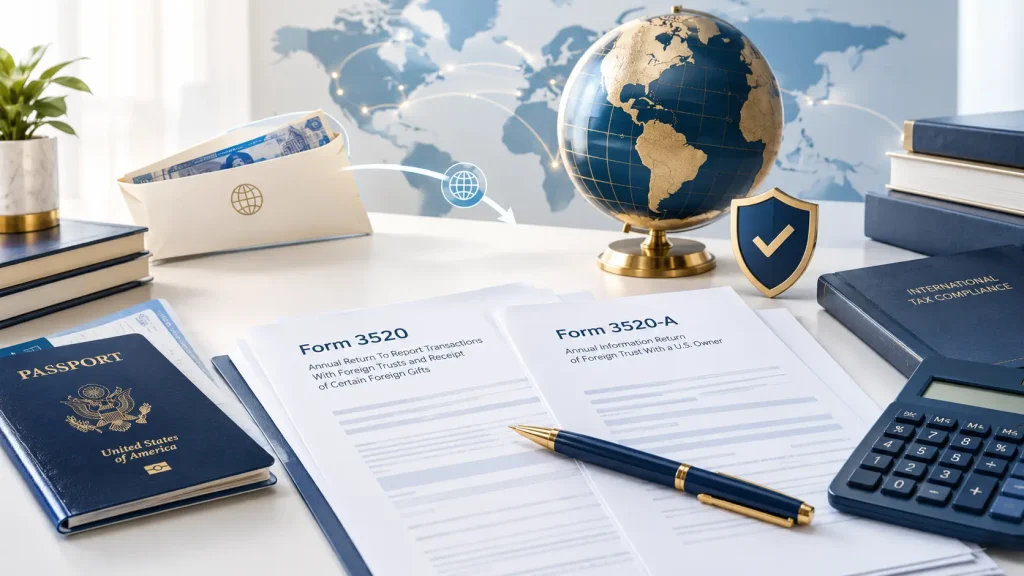
Receiving a large gift, inheritance, or other money from family overseas can be a wonderful thing. It can also come with a U.S. tax reporting requirement that many people do not know about.
For many U.S. citizens, green card holders, and other U.S. persons, receiving a genuine foreign gift or inheritance does not automatically mean the money is taxable income. However, certain foreign gifts, bequests, and transactions involving foreign trusts must still be reported to the IRS.
Two forms are especially important:
- Form 3520, Annual Return To Report Transactions With Foreign Trusts and Receipt of Certain Foreign Gifts
- Form 3520-A, Annual Information Return of Foreign Trust With a U.S. Owner
These are generally information-reporting forms rather than ordinary income tax returns. They give the IRS information about certain foreign gifts, foreign trusts, and transactions involving those trusts.
The problem is that failing to file the correct form, filing it late, or providing incomplete or incorrect information can result in significant penalties.
If you have received an IRS penalty notice or recently discovered that you should have filed Form 3520 or Form 3520-A, it is important to understand what happened and what options may be available.
International Tax Consultants helps taxpayers review international reporting issues and evaluate whether they may qualify for IRS penalty relief.
What Are Form 3520 and Form 3520-A?
Although the forms are often discussed together, they serve different purposes.
Form 3520
Form 3520 is generally used by a U.S. person to report certain transactions involving foreign trusts, certain foreign trust ownership information, and certain large gifts or bequests received from foreign persons.
For example, Form 3520 may be relevant if you:
- Receive a large gift from a foreign individual
- Receive a large inheritance or bequest from a foreign estate
- Transfer money or property to certain foreign trusts
- Receive a distribution from a foreign trust
- Have certain foreign trust ownership reporting obligations
The exact requirement depends on the circumstances.
Form 3520-A
Form 3520-A is different.
It is an annual information return for a foreign trust that has a U.S. owner. The form provides information about the foreign trust, its U.S. owners, and its U.S. beneficiaries.
A foreign trust with a U.S. owner generally has an obligation to file Form 3520-A. If the foreign trust does not file it, the U.S. owner may have to prepare and attach a substitute Form 3520-A to the owner’s Form 3520.
The distinction matters because the penalties can be substantial.
When Do You Need to File Form 3520?
There are several situations in which Form 3520 may be required. Two of the most common are large foreign gifts and transactions involving foreign trusts.
Reporting Large Foreign Gifts and Bequests
If you are a U.S. person and receive more than $100,000 during the tax year from a nonresident alien individual or foreign estate as a gift or bequest, you generally must report the amount on Form 3520.
Certain gifts from related foreign persons must be combined when determining whether the $100,000 threshold has been exceeded.
For example, suppose you receive:
- $75,000 from one nonresident alien, and
- $40,000 from another nonresident alien who you know is related to the first donor.
The combined amount is $115,000.
Because the total exceeds $100,000, Form 3520 reporting may be required.
The rules are different when a purported gift comes from a foreign corporation or foreign partnership. For 2026, the applicable threshold is $20,573, subject to the applicable inflation-adjustment rules. The IRS can also recharacterize a purported gift from a foreign corporation or partnership in certain circumstances.
Are Foreign Gifts and Inheritances Taxable?
This is one of the most important points to understand.
A genuine gift or inheritance from a foreign person is generally not treated as taxable income to the recipient simply because the money came from outside the United States.
However, not being taxable does not necessarily mean that it does not have to be reported.
For example, a U.S. person may receive a $150,000 gift from a parent living overseas. The gift may not itself be taxable income, but the recipient may still have to report it to the IRS on Form 3520.
There are also special rules for certain gifts and bequests from covered expatriates, which can create additional U.S. tax consequences.
Because the tax and reporting rules are different, it is important not to assume that “not taxable” means “nothing needs to be reported.”
Reporting Transactions Involving a Foreign Trust
Form 3520 can also be required when a U.S. person has certain transactions involving a foreign trust.
Depending on the circumstances, these can include:
- Transferring money or property to a foreign trust
- Having certain ownership interests in a foreign trust
- Receiving a distribution from a foreign trust
- Receiving certain loans or other benefits from a foreign trust
Foreign trust reporting can become complicated quickly.
The correct treatment depends on how the trust is structured, who owns it for U.S. tax purposes, who receives distributions, and what type of transaction occurred.
If the foreign trust has a U.S. owner, Form 3520-A may also be required.
When Are Form 3520 and Form 3520-A Due?
Understanding the deadlines is important because late filing can lead to significant penalties.
Form 3520 Deadline
For most calendar-year individual taxpayers, Form 3520 is generally due on the 15th day of the fourth month after the end of the tax year, which is generally April 15.
The rules can be different for taxpayers who live and work outside the United States. Under the current IRS instructions, those taxpayers generally have until the 15th day of the sixth month after the end of the tax year.
An extension may also apply in certain circumstances when the taxpayer has properly extended the related income tax return.
Because the deadline can depend on the taxpayer’s circumstances, it is better to check the current IRS instructions rather than assume that Form 3520 always follows the same deadline as the taxpayer’s income tax return.
Form 3520-A Deadline
Form 3520-A is generally due on the 15th day of the third month after the end of the foreign trust’s tax year.
For a calendar-year foreign trust, this generally means March 15.
If the foreign trust does not file Form 3520-A, the U.S. owner may be able to avoid the penalty by preparing a substitute Form 3520-A and attaching it to the owner’s Form 3520 by the Form 3520 filing deadline.
This is an important distinction. The regular Form 3520-A deadline and the deadline for a substitute Form 3520-A attached to Form 3520 are not necessarily the same.
What Happens If Form 3520 or Form 3520-A Is Filed Late?
The potential penalty depends on what was not reported.
There is no single “Form 3520 penalty” that applies to every situation.
Penalties for Certain Foreign Gifts
For certain reportable foreign gifts and bequests, the penalty can be 5% of the amount of the unreported gift for each month, or part of a month, that the failure continues.
The total penalty is generally limited to 25% of the unreported gift.
For example, a $1 million reportable foreign gift could potentially result in a penalty of up to $250,000 if the statutory maximum applies.
That does not mean every late Form 3520 involving a $1 million gift will automatically result in a $250,000 penalty. The facts, length of the failure, applicable reporting rules, and potential reasonable-cause relief all matter.
Penalties for Certain Transfers to Foreign Trusts
A different penalty structure applies to certain failures involving transfers to foreign trusts.
The initial penalty can generally be the greater of:
- $10,000, or
- 35% of the gross value of the property transferred to the foreign trust.
This is very different from the penalty that applies to certain unreported foreign gifts.
Penalties for Certain Foreign Trust Distributions
A U.S. person who fails to properly report certain distributions from a foreign trust may face an initial penalty that is generally the greater of:
- $10,000, or
- 35% of the gross amount of the distribution.
The exact rules depend on the transaction and the reporting failure.
Penalties Involving Foreign Trust Ownership and Form 3520-A
A separate penalty can apply when a foreign trust with a U.S. owner fails to file Form 3520-A or fails to provide the required information.
The initial penalty can generally be the greater of:
- $10,000, or
- 5% of the gross value of the portion of the trust’s assets treated as owned by the U.S. person.
This is one reason foreign trust reporting should not be treated as a routine paperwork issue.
What Happens After the IRS Sends a Penalty Notice?
The potential financial exposure can increase if a reporting failure continues after the IRS has sent a notice.
For certain Form 3520 and Form 3520-A failures, if the taxpayer does not correct the failure within 90 days after the IRS mails the notice, an additional penalty of $10,000 can generally apply for each 30-day period, or part of a 30-day period, that the failure continues.
There are statutory limits on the total penalties that can apply.
The rules are different depending on which part of Form 3520 or Form 3520-A is involved, so it is important to read the IRS notice carefully and determine exactly what the IRS says was not reported.
If you receive a penalty notice, do not simply assume that the amount shown is unavoidable.
Example: How a Foreign Gift Penalty Can Add Up
Consider a U.S. taxpayer who receives a reportable $1 million gift from a foreign person but does not timely report it on Form 3520.
For certain foreign gift reporting failures, the penalty can be 5% of the unreported gift for each month, or part of a month, up to a maximum of 25%.
If the maximum penalty applies:
$1,000,000 × 25% = $250,000
A $250,000 penalty would obviously be serious.
But this example does not mean that every taxpayer who files Form 3520 late will owe $250,000.
The actual outcome depends on the specific reporting requirement, how long the failure continued, the circumstances surrounding the failure, and whether the taxpayer can establish reasonable cause.
That is why it is important to review the underlying facts before accepting an IRS penalty as final.
Can an IRS Form 3520 or Form 3520-A Penalty Be Removed?
In some circumstances, yes.
The IRS provides reasonable-cause relief for certain penalties when a taxpayer can demonstrate that the failure was due to reasonable cause and not willful neglect.
In plain English, the taxpayer generally needs to show that there was a legitimate reason for the failure and that the taxpayer acted appropriately under the circumstances.
Every case is different.
Depending on the facts, a reasonable-cause explanation may address:
- Why the filing was missed
- What the taxpayer knew or did not know at the time
- What steps the taxpayer took to comply
- Whether the taxpayer relied on professional advice
- Whether circumstances outside the taxpayer’s control contributed to the failure
- How quickly the taxpayer acted after discovering the problem
- Whether the missing filing was corrected
Simply saying, “I did not know I had to file Form 3520,” does not automatically establish reasonable cause.
Likewise, hiring an accountant or tax professional does not automatically establish reasonable cause. The IRS may consider the circumstances surrounding the professional advice and the taxpayer’s reliance on that advice.
The strength of a penalty-relief request depends on the facts and the supporting evidence.
What Should You Do If You Missed Form 3520 or Form 3520-A?
If you discover that you have missed an international information return, do not ignore the problem.
The first step is to determine exactly what happened and what should have been reported.
A practical review usually starts with the following steps.
1. Identify the Reporting Requirement
Determine whether the issue involves:
- A foreign gift or inheritance
- A transfer to a foreign trust
- A distribution from a foreign trust
- Foreign trust ownership
- A missing Form 3520-A
- Another international information reporting requirement
Different situations can trigger different forms, deadlines, and penalties.
2. Gather Your Financial and Trust Records
You will need enough information to reconstruct what happened.
Depending on your situation, this may include:
- Bank statements
- Wire transfer records
- Gift letters
- Estate documents
- Trust agreements
- Foreign trust financial statements
- Records of property transfers
- Previous tax returns
- Correspondence with accountants or tax advisors
- IRS notices
The goal is to establish an accurate timeline and determine the amounts involved.
3. Prepare the Missing Information Returns
Past-due forms should be prepared carefully and consistently with the taxpayer’s other tax records.
If a foreign trust is involved, particular attention should be given to the information required on Form 3520-A and whether a substitute Form 3520-A needs to be attached to Form 3520.
4. Evaluate Whether Penalty Relief May Apply
If the IRS has already assessed a penalty, or you are concerned that a late filing may result in one, the next question is whether the facts support a reasonable-cause request.
A strong submission should clearly explain:
- What happened
- Why the filing was missed
- What the taxpayer did to comply
- When the problem was discovered
- What corrective steps were taken
- Why the circumstances support penalty relief
Supporting documents can be very important.
5. Respond to IRS Notices Carefully
If you receive an IRS penalty notice, do not ignore it.
Read the notice carefully and identify:
- What form or reporting requirement the IRS says was missed
- Which tax year is involved
- The amount of the proposed or assessed penalty
- The deadline for responding
- What the IRS is asking you to do
Because Form 3520 and Form 3520-A penalties can be substantial, having an experienced international tax professional review the notice and underlying facts may help you determine the appropriate response.
Frequently Asked Questions
Is a foreign gift or inheritance taxable income in the United States?
Generally, a genuine gift or inheritance received from a foreign person is not treated as taxable income to the U.S. recipient.
However, certain foreign gifts and bequests must still be reported to the IRS.
Special rules can also apply to gifts or bequests from covered expatriates.
For example, a U.S. person who receives more than $100,000 in reportable gifts or bequests from a nonresident alien individual or foreign estate during the year may need to file Form 3520.
Do I have to report every gift I receive from someone overseas?
No.
The Form 3520 foreign-gift rules generally apply when the applicable reporting threshold is exceeded.
For gifts or bequests from a nonresident alien individual or foreign estate, the general threshold is more than $100,000 during the tax year, subject to aggregation rules for certain related foreign persons.
Different rules apply to purported gifts from foreign corporations and foreign partnerships.
What should I do if I receive an IRS penalty notice for Form 3520?
Do not ignore it.
First, determine what reporting requirement the IRS believes was missed and note the response deadline.
Then review the underlying Form 3520 issue, the amount involved, and the circumstances that caused the filing failure.
If reasonable cause may apply, you may be able to request penalty relief.
Because the potential penalties can be substantial, having an international tax professional review the notice and underlying facts can help you determine the appropriate response.
Can a Form 3520 or Form 3520-A penalty be canceled?
Potentially.
The IRS provides reasonable-cause relief for certain Form 3520 and Form 3520-A penalties when the taxpayer can demonstrate that the failure was due to reasonable cause and not willful neglect.
Penalty relief is not automatic.
The taxpayer needs to establish the facts supporting the request and provide an appropriate explanation and supporting documentation.
What is the difference between Form 3520 and Form 3520-A?
The easiest way to remember the difference is:
Form 3520 generally reports certain transactions involving U.S. persons and foreign trusts, as well as certain large foreign gifts or bequests.
Form 3520-A is the annual information return for a foreign trust with a U.S. owner.
If a foreign trust with a U.S. owner does not file Form 3520-A, the U.S. owner may need to prepare and attach a substitute Form 3520-A to Form 3520.
What are the due dates for Form 3520 and Form 3520-A?
For most calendar-year individual taxpayers, Form 3520 is generally due April 15.
Certain taxpayers who live and work outside the United States generally have a later statutory deadline.
Form 3520-A is generally due March 15 for a calendar-year foreign trust.
A substitute Form 3520-A prepared by a U.S. owner is generally attached to Form 3520 and follows the Form 3520 filing deadline.
Because individual circumstances can affect the filing deadline, taxpayers should check the current IRS instructions before filing.
Should I hire a professional for Form 3520 penalty defense?
You can communicate with the IRS yourself.
However, international information reporting can involve complicated rules and potentially significant penalties.
If you have an unfiled Form 3520 or Form 3520-A, or if you have received an IRS penalty notice, an experienced international tax professional can review the facts, determine which reporting requirements apply, and evaluate whether reasonable-cause penalty relief may be available.
International Tax Consultants assists taxpayers with international tax compliance and IRS penalty matters, including evaluating and preparing reasonable-cause penalty relief submissions.
Need Help With a Form 3520 or Form 3520-A Issue?
A missed international information return does not necessarily mean that a substantial IRS penalty is unavoidable.
The appropriate response depends on the type of filing involved, the amount that should have been reported, how long the filing was overdue, the taxpayer’s circumstances, and whether reasonable cause can be established.
If you have received an IRS penalty notice or discovered a past-due Form 3520 or Form 3520-A, International Tax Consultants can review your situation and help determine the appropriate compliance and penalty-relief strategy.
Getting professional advice early can be especially important when an IRS notice includes a significant penalty or gives you a limited time to respond.