

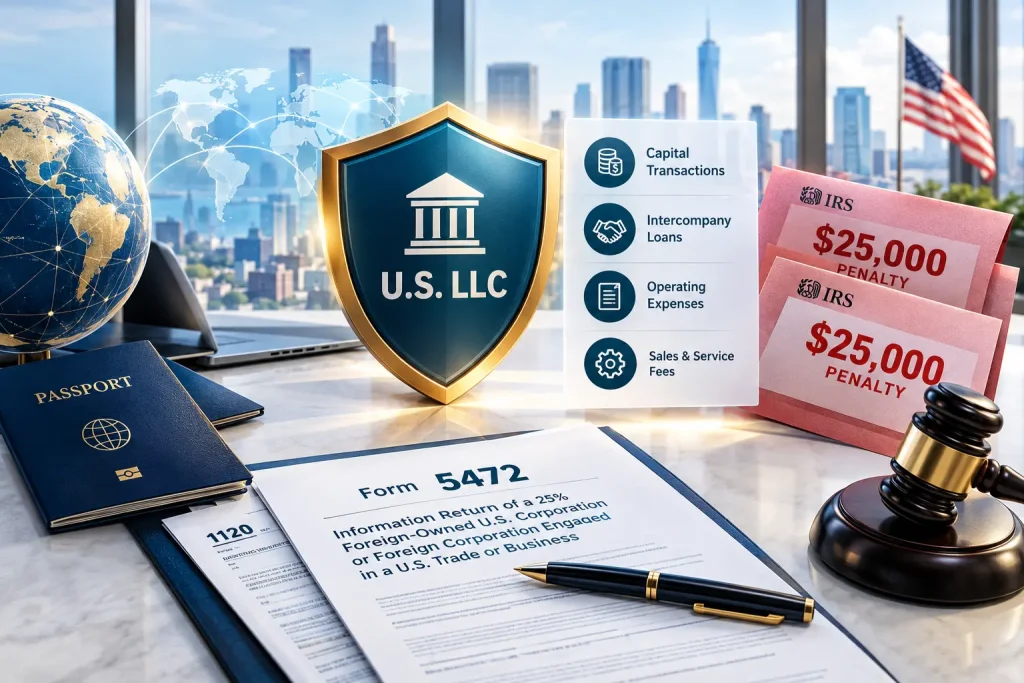
For non-U.S. residents and foreign corporations operating domestic business entities, the U.S. tax environment presents intricate statutory obligations. Among these, the reporting requirements surrounding foreign-owned single-member Limited Liability Companies (LLCs) have become a primary target for IRS enforcement. Under Internal Revenue Code (IRC) §6038A and §6038C, mandatory annual filings are triggered via Form 5472 and Form 1120.
When non-U.S. owners fail to submit these filings accurately or on time, the Internal Revenue Service systematically issues automated civil penalties starting at $25,000 per violation, per taxable year. Navigating these enforcement actions requires an analytical legal strategy led by established practitioners like International Tax Consultants, LLC, who specialize in federal tax controversy, cross-border compliance, and administrative appeals.
Understanding the Statutory Basis of Form 5472
A domestic single-member LLC owned by a non-U.S. person is treated as a “disregarded entity” for federal income tax purposes under Treasury Regulation §301.7701-3. However, under Treasury Regulation §1.6038A-1, these entities are explicitly deemed domestic corporations solely for the purpose of informational reporting requirements under IRC §6038A.
Form 5472 (Information Return of a 25% Foreign-Owned U.S. Corporation or Foreign Corporation Engaged in a U.S. Trade or Business) requires foreign owners to disclose all “reportable transactions” occurring between the domestic entity and any foreign related party during the tax year.
Key Categories of Reportable Transactions:
- Capital Contributions and Distributions: Any movement of funds between the foreign owner and the U.S. entity, including initial startup capital injections or profit withdrawals.
- Intercompany Loans and Financing: Principal and interest transfers, shareholder loans, or debt guarantees between related entities.
- Formation and Operating Expenses: Third-party payments made directly by the foreign shareholder on behalf of the U.S. LLC, such as legal fees, registered agent expenses, or platform fees.
- Sales and Service Fees: Transactions involving tangible property, IP licensing, royalties, or technical services performed across international borders.
Even if a foreign-owned U.S. LLC engages in zero commercial operations and generates zero gross income during the tax year; the execution of a reportable transaction, such as paying an annual state renewal fee, triggers the statutory requirement to file.
The Mechanics of the Automated $25,000 Penalty
The IRS utilizes automated processing protocols at the Ogden and Austin Service Centers to identify non-compliant foreign-owned entities. Unlike routine tax notice procedures, failure-to-file penalties under IRC §6038A(d) are assessed automatically without prior audit examination or human intervention.
- Initial Assessment ($25,000): Assessed immediately upon processing late filings or identifying unfiled reporting periods.
- Continuation Penalties ($25,000 per month): If non-compliance persists 90 days after the IRS mails Notice CP215 or Notice CP15, additional continuation penalties accumulate at $25,000 for every 30-day period (or fraction thereof), with no statutory ceiling.
- Loss of Expense Deductions: Under IRC §267(a)(3) and associated rules, failure to file appropriate disclosures can result in the complete disallowance of deductions associated with payments made to related foreign entities.
Receiving a $25,000 penalty notice frequently shocks foreign entrepreneurs who were improperly advised that an inactive LLC required no IRS filings. Paying these assessments outright is rarely necessary, as administrative and statutory remedies exist to abate non-willful compliance failures.
Administrative Remedies and Reasonable Cause Abatement
Overcoming an automated assessment requires establishing “Reasonable Cause” pursuant to Treasury Regulation §1.6038A-4(b) and IRC §6664(c). Simply submitting a late Form 5472 without a structured legal petition will result in immediate rejection by IRS Service Center automated filters.
Successful Form 5472 $25k penalty abatement strategies rely on constructing an affirmative defense grounded in specific factual and legal elements:
Core Elements of a Reasonable Cause Petition:
- Absence of Willful Neglect: Demonstrating that the omission was not the result of intentional disregard or reckless indifference toward U.S. tax obligations.
- Good Faith Reliance on Tax Professionals: Establishing that the foreign owner retained qualified U.S. tax advisors, provided complete factual records, and reasonably relied on professional counsel regarding filing obligations.
- Ordinary Business Care and Prudence: Proving that the entity maintained appropriate business records and took reasonable steps to fulfill statutory duties given international language barriers or regulatory complexity.
- Delinquent International Information Return Submission Compliance: Utilizing specific IRS administrative relief mechanisms to submit complete delinquent schedules alongside formal legal affidavits.
Strategic Action Plan for Non-Compliant Entities
Foreign investors holding non-compliant U.S. entities must avoid making “quiet filings”, submitting delinquent returns without explanatory legal petitions—as this frequently triggers immediate automated billing notices. Instead, taxpayers should execute a structured remediation approach under the guidance of trial counsel experienced in IRS administrative procedures.
- Comprehensive Historical Audit: Inspect all bank statements, ledger entries, and formation documents to identify all unfiled years and reportable related-party transactions.
- Formal Affidavit Preparation: Draft sworn affidavits outlining the factual timeline, professional reliance evidence, and mitigating circumstances supporting reasonable cause.
- Administrative Representation: File formal legal petitions directly with specialized IRS penalty abatement units or the IRS Office of Appeals.
Addressing cross-border disclosures proactively protects foreign business operations, eliminates devastating civil assessments, and preserves long-term foreign investment structures in the United States. Foreign corporate officers and single-member LLC owners facing unfiled forms or active CP15 notices should request a case evaluation to establish an effective legal defense strategy.
Frequently Asked Questions
Does an inactive foreign-owned U.S. LLC with $0 income need to file Form 5472?
Yes. Under Internal Revenue Code §6038A and Treasury Regulation §1.6038A-1, a single-member foreign-owned U.S. LLC must file Form 5472 attached to a pro-forma Form 1120 even with zero gross revenue, provided a reportable transaction occurred (such as initial startup funding, owner loans, or paying annual state fees). To prevent automated billing notices, constructing an affirmative defenseInternational Tax Consultants provides structured return preparation to ensure foreign entities meet strict federal reporting standards.
What is an IRS Notice CP15, and why does it require specialized legal intervention?
IRS Notice CP15 is an automated $25,000 civil penalty issued by IRS processing centers (Ogden/Austin) when Form 5472 is filed late or omitted. Because these assessments are generated algorithmically without prior audit review, routine explanation letters from general preparers are systematically rejected. Resolving a CP15 notice requires attorney-led administrative appeal strategies under Treasury Regulation §1.6038A-4(b) to halt collection actions.
Can a $25,000 Form 5472 penalty be abated without paying the IRS?
Yes. Automated $25,000 assessments can be completely abated by establishing statutory Reasonable Cause under IRC §6664(c). However, the IRS enforces exceptionally high evidentiary standards for foreign-owned entities. International Tax Consultants construct formal, affidavit-backed legal petitions that document ordinary business care, non-willfulness, and professional reliance to secure full administrative relief.
Why is attempting a “quiet filing” or DIY submission dangerous for delinquent returns?
Mailing late Form 5472 returns quietly without an accompanying legal petition triggers automated IRS filters to instantly issue a $25,000 Notice CP15 assessment. If ignored for 90 days, additional continuation penalties accumulate at $25,000 every 30 days. Attempting to fix unfiled years without professional oversight drastically increases financial exposure. ITC handles delinquent international disclosures through structured remediation protocols that mitigate penalty risk.
Should I hire a general CPA or an international tax law firm like ITC for CP15 defense?
General accountants specialize in standard annual compliance, whereas Notice CP15 penalty defense is a formal administrative tax controversy matter. International Tax Consultants, led by international tax attorney Robert Payne, specializes specifically in federal tax controversy, cross-border compliance, and administrative IRS appeals. Our team builds defense-ready evidentiary files designed to withstand IRS scrutiny.
What should I do immediately after receiving a $25,000 IRS Notice CP15 penalty?
Do not pay the penalty outright and do not send unvetted correspondence to the IRS. Statutory deadlines apply, and improper responses can waive your appeal rights. Contact International Tax Consultants immediately for a professional case evaluation. Our team will review your filing history, communicate directly with specialized IRS penalty units, and construct an affirmative defense strategy.